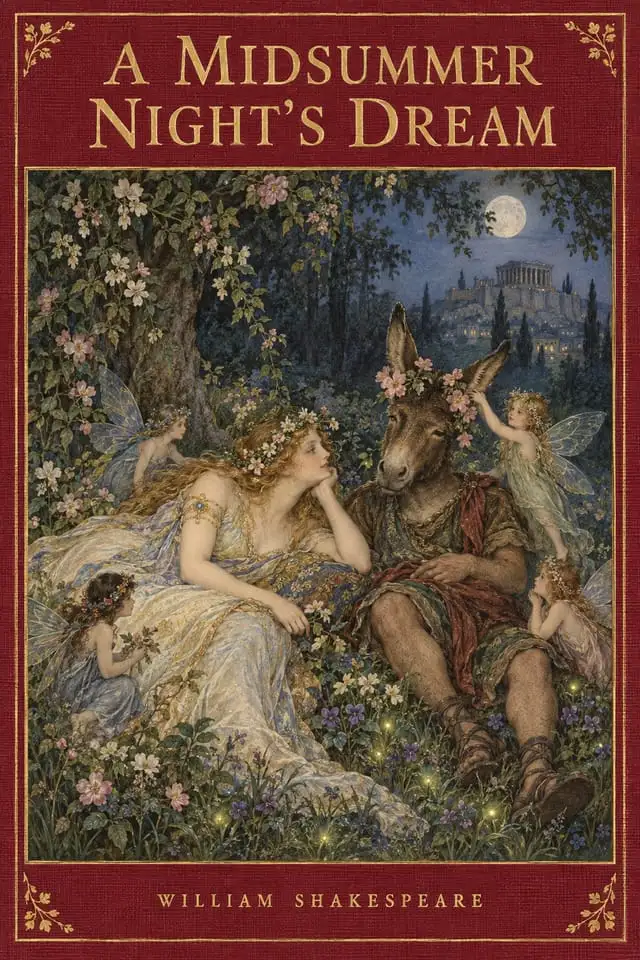
Characters
- TheseusHe doubts the lovers' account, chooses the craftsmen's play as sincere service and comments throughout their performance.First appears: Act 1, Scene 1
- HippolytaShe questions Theseus's dismissal of the lovers' shared story and finds the craftsmen's play foolish, though she expresses pity during it.First appears: Act 1, Scene 1
- PhilostrateTheseus sends Philostrate to stir up the young people of Athens to merriment for the coming wedding.First appears: Act 1, Scene 1
- EgeusHe again demands the law against the escaping lovers, but Theseus overrides his wishes.First appears: Act 1, Scene 1
- HermiaTheseus overrides her father's demand for punishment and orders that she marry Lysander.First appears: Act 1, Scene 1
- LysanderAwake again, he admits the planned escape with Hermia and receives Theseus's permission to marry her.First appears: Act 1, Scene 1
- DemetriusHe declares that his love for Hermia has vanished and his old attachment to Helena has returned, and Theseus orders their marriage.First appears: Act 1, Scene 1
- HelenaDemetrius now declares his love for her and Theseus orders their marriage, though she finds the reunion strangely dreamlike.First appears: Act 1, Scene 1
- QuinceHis prologue's misplaced pauses confuse its meaning as he introduces the craftsmen's performance.First appears: Act 1, Scene 2
- SnugPlaying the Lion, he reassures the ladies that he is really Snug the joiner.First appears: Act 1, Scene 2
- BottomHe performs Pyramus, answers the court's comments while acting and rises after his staged death to offer further entertainment.First appears: Act 1, Scene 2
- FluteHe performs Thisbe, who finds Pyramus dead and kills herself in the craftsmen's play.First appears: Act 1, Scene 2
- SnoutHe performs the Wall, using his fingers to show the chink through which the lovers speak.First appears: Act 1, Scene 2
- StarvelingHe presents Moonshine with a lantern, thorn-bush and dog, and explains his role under the court's questioning.First appears: Act 1, Scene 2
- PuckAfter the fairy blessings he asks the audience to pardon the performance as a dream and give their hands in friendship.First appears: Act 2, Scene 1
- A fairyA fairy who serves Titania, the fairy queen, and recognises Puck as the mischievous spirit Robin Goodfellow.First appears: Act 2, Scene 1
- OberonHaving obtained the Indian boy from the enchanted Titania, he releases her and renews their friendship.First appears: Act 2, Scene 1
- TitaniaReleased from the charm after giving Oberon the boy, she loathes Bottom's appearance and joins Oberon in renewed friendship.First appears: Act 2, Scene 1
- PeaseblossomOne of Titania's fairies, commanded to attend Bottom and make him welcome.First appears: Act 3, Scene 1
- CobwebOne of Titania's fairies, commanded to attend Bottom and make him welcome.First appears: Act 3, Scene 1
- MothOne of Titania's fairies, commanded to attend Bottom and make him welcome.First appears: Act 3, Scene 1
- MustardseedOne of Titania's fairies, commanded to attend Bottom and make him welcome.First appears: Act 3, Scene 1
Themes
- Love and desire
- Authority and the law
- Gender and power
- Imagination and dreams
- Theatre and performance
- Rank and social class
- Magic and the natural world
Chapter summaries
Act 1, Scene 1
Theseus, duke of Athens, looks forward to his wedding to Hippolyta in four days and says he won her love with his sword. Egeus then complains that Lysander has stolen his daughter Hermia's heart, and claims the ancient law of Athens that lets him give her to Demetrius or to her death. Theseus tells Hermia that her father should be like a god to her, and gives her until his wedding day to choose between marrying Demetrius, dying or living single as a vowed servant of Diana. Left alone, Lysander and Hermia agree that true love always meets obstacles, then plan to meet in the wood and go to his aunt's house, where Athenian law cannot reach them. They share the secret with Helena, who loves Demetrius although he abandoned her for Hermia. In a soliloquy Helena argues that love sees with the mind rather than the eyes, and decides to tell Demetrius of the plan. The scene sets the power of fathers and the law against the choices of the young, and repeatedly asks whose eyes should judge in love.
Act 1, Scene 2
At Quince's house, a group of Athenian working men gather to cast a play for the duke's wedding night, The Most Lamentable Comedy, and Most Cruel Death of Pyramus and Thisbe. Quince calls each man by name and trade, and gives Bottom the weaver the part of Pyramus, a lover who kills himself for love. Bottom wants more parts as well, offering to take Thisby in a little voice and the lion with a roar that would make the duke ask for more. The others are more anxious: Flute does not want to play a woman, Snug fears he is slow to learn, and all agree that a roar which frightened the ladies would get them hanged. Their fear shows how much they depend on the goodwill of the court. Bottom's misused words, such as promising to 'aggravate' his voice so that he roars gently, add to the comedy. Quince flatters Bottom into accepting Pyramus and arranges a secret rehearsal by moonlight in the palace wood.
Act 2, Scene 1
The play moves from Athens into the wood, where a fairy and Puck reveal that the fairy king and queen, Oberon and Titania, are quarrelling over an Indian boy whom Titania keeps as her attendant and Oberon wants as his henchman. The fairy's description of Puck as Robin Goodfellow, who skims the milk, spoils the churning and misleads night-wanderers, brings a world of mischief alongside the human one. When the king and queen meet they accuse each other of loving Theseus and Hippolyta, and Titania describes floods, rotting corn and seasons out of order, saying that she and Oberon are the parents of these evils. Their quarrel echoes the conflict in Athens, where Egeus demanded Hermia's obedience: Oberon asks 'am not I thy lord?', and Titania refuses him out of loyalty to the boy's dead mother, who was her votaress. Oberon sends Puck for the flower love-in-idleness, turned purple by Cupid's arrow, and plans to use its juice to make Titania dote on a beast until she gives up the boy. Invisible, he watches Demetrius threaten Helena, who calls herself his spaniel and complains that women cannot fight for love as men can. Oberon promises that Helena will soon flee Demetrius and he will seek her love, and tells Puck to anoint the eyes of the disdainful Athenian, so the fairies' magic now reaches into the affairs of the human lovers.
Act 2, Scene 2
Titania's fairies sing a lullaby to keep snakes, spiders and beetles from their queen, and once she sleeps Oberon squeezes the flower on her eyelids and wishes that she wakes when some vile thing is near. Lysander and Hermia, lost and tired, lie down to rest, and Hermia's gentle insistence that he sleep further off shows her care for modesty even while she is running away with him. Puck finds Lysander in Athenian clothes lying apart from Hermia, reads the distance as scorn and puts the charm on his eyes; the audience knows that the youth Oberon saw scorning Helena was Demetrius, so this dramatic irony shows the magic going to the wrong man. Helena, left alone by Demetrius, wakes Lysander, who at once declares his love for her and claims that reason has led him to it, though the audience has just watched the flower cause it. Helena believes she is being mocked and leaves in distress, and Lysander leaves vowing to be her knight after wishing Hermia hated by all. Hermia wakes from a dream of a serpent eating her heart while Lysander sat smiling, and goes into the dark wood alone to find him. The scene shows how easily love can be changed from outside, while the lovers still speak of their feelings as their own choices.
Act 3, Scene 1
The craftsmen worry that their acted violence and lion will terrify the ladies, so Bottom proposes explanations that repeatedly break the illusion of a play. Their plans for a human Wall and Moonshine turn practical stage problems into comedy. Watching unseen, Puck becomes an actor in their rehearsal by transforming Bottom's head. Bottom misunderstands his friends' terror as a joke against him, and sings to prove his courage. Titania's enchanted admiration then calls the ass-headed weaver beautiful and wise, while he himself questions her judgement. Her command that he must remain whether he wishes it or not gives this comic encounter an element of coercion.
Act 3, Scene 2
Puck celebrates Titania's love for the transformed Bottom, but Hermia's arrival with Demetrius exposes his mistake with the Athenian lovers. Oberon charms Demetrius, intending Helena to become his beloved. With both men declaring love, Helena interprets apparent success as a conspiracy to humiliate her. Her recollection of childhood intimacy with Hermia makes the collapse of their friendship especially painful. The women exchange insults about height while the men treat possession of Helena as something to settle by combat. Puck enjoys their confusion, whereas Oberon orders him to prevent injury and restore Lysander's earlier attachment. By the close, the four sleep near one another and Puck has applied the remedy, but they have not yet woken to test it.
Act 4, Scene 1
Bottom's appetite for hay and peas makes his transformation physical as well as visual, while Titania continues to lavish affection on him. Oberon reports that she has surrendered the Indian boy, then removes the enchantment and restores their partnership. Her immediate disgust at Bottom marks another abrupt reversal of perception. The court arrives at dawn, and Lysander admits the intended escape while Egeus again demands punishment. Demetrius describes his recovered love for Helena as a return to health, although the audience has seen the charm applied to him and has seen no remedy used on his eyes. Theseus overrides Egeus and orders both couples to marry alongside him and Hippolyta. The lovers struggle to decide whether they are awake, and Bottom similarly finds his experience beyond ordinary language as he imagines a ballad called Bottom's Dream.
Act 4, Scene 2
Without Bottom, the craftsmen believe their play cannot proceed, despite the problems his confidence caused during rehearsal. Flute's imagined daily pension makes clear that the performance offers a hope of material advancement. Their praise contains another verbal mistake when Quince confuses a paragon with a paramour. Bottom returns to joyful greetings and promises an extraordinary account, then refuses to tell it. He turns at once to practical instructions about costumes, nails and breath. The quick scene returns the action from private bewilderment to the shared work of putting on a play.
Act 5, Scene 1
Theseus associates lovers, poets and madmen through their imaginative power, but Hippolyta argues that the lovers' common story has a consistency beyond individual fancy. He chooses the craftsmen's play despite Philostrate's objections, saying sincere service deserves a generous reception. During the performance, confused punctuation and literal explanations repeatedly expose the machinery of representation. The court comments and interrupts, although Hippolyta eventually expresses pity for Pyramus. The lovers' staged deaths make a comic counterpart to the threatened separation and violence in the main action. When the humans leave, Oberon and Titania bring the fairy world into the palace through blessings on the couples and their children. Puck's final appeal offers spectators the freedom to treat what they have seen as a dream and asks for their applause.
Key quotes
I beg the ancient privilege of Athens, As she is mine, I may dispose of her:
Egeus speaks of his daughter as property he can hand over or destroy. The law of Athens supports him, which turns Hermia's refusal into a matter of life and death rather than a family quarrel.
Authority and the lawGender and power
The course of true love never did run smooth;
Lysander turns their trouble into a general rule drawn from stories and history. It frames the lovers' situation as part of a long tradition of love meeting obstacles.
Love and desire
Love looks not with the eyes, but with the mind; And therefore is wing'd Cupid painted blind:
Helena suggests that love is not based on what is really seen, which explains how Demetrius can prefer Hermia when Helena is thought just as fair. It links love to the mind's own imaginings rather than to judgement.
Love and desireImagination and dreams
Nay, faith, let not me play a woman; I have a beard coming.
Flute objects to playing a woman because his beard is beginning to grow. The comedy exposes a practical gap between an actor's appearance and the role he must perform.
Theatre and performanceGender and power
An you should do it too terribly, you would fright the duchess and the ladies, that they would shriek; and that were enough to hang us all.
Quince fears that a performance which is too convincing could cost them their lives. The craftsmen's anxiety shows the gap in power between them and the court they hope to please.
Rank and social classAuthority and the lawTheatre and performance
I will roar you as gently as any sucking dove; I will roar you an 'twere any nightingale.
Bottom promises a roar that is both fierce and gentle, which is a contradiction. His confidence and muddled language make him the comic centre of the group.
Theatre and performance
And this same progeny of evils comes From our debate, from our dissension; We are their parents and original.
Titania blames the floods, failed harvests and confused seasons on her quarrel with Oberon. The fairy rulers' private conflict spreads disorder through the whole natural world.
Magic and the natural worldAuthority and the law
The juice of it on sleeping eye-lids laid Will make or man or woman madly dote Upon the next live creature that it sees.
Oberon describes a love that is caused from outside and fixes on whatever is seen first. It suggests that love may have little to do with the worth of the person loved.
Love and desireMagic and the natural worldImagination and dreams
We cannot fight for love, as men may do; We should be woo'd and were not made to woo.
Helena knows that by chasing Demetrius she is breaking the rules for how women should behave in love. Her complaint shows how those rules leave her without power.
Gender and powerLove and desire
Wake when some vile thing is near.
Oberon's spell ends by wishing something ugly on his own queen. His magic is a way of punishing Titania and forcing her to obey him.
Magic and the natural worldAuthority and the lawGender and power
The will of man is by his reason sway'd; And reason says you are the worthier maid.
Lysander insists that reason has made him prefer Helena, but the audience has just seen Puck's charm put on his eyes. The dramatic irony mocks the lovers' belief that they choose freely.
Love and desireMagic and the natural worldImagination and dreams
Methought a serpent eat my heart away, And you sat smiling at his cruel prey.
Hermia's nightmare matches what has just happened while she slept, as Lysander has turned against her. The dream gives shape to a betrayal she slept through and has not seen.
Imagination and dreamsLove and desire
reason and love keep little company together now-a-days
Bottom supplies a plain judgement on Titania's attraction even as he benefits from it. The audience knows the magical cause of what seems to her a compelling love.
Love and desireMagic and the natural world
Thou shalt remain here, whether thou wilt or no.
Titania's promise of luxury also removes Bottom's freedom to leave. Her royal authority complicates the apparent reversal of rank in her love for a craftsman.
Authority and the lawRank and social classGender and power
Lord, what fools these mortals be!
Puck treats the lovers' anguish as entertaining folly. His detached pleasure asks an audience to consider its own laughter at people who do not understand their situation.
Love and desireTheatre and performanceMagic and the natural world
And will you rent our ancient love asunder, To join with men in scorning your poor friend?
Helena places the women's old friendship against an apparent alliance with the men. The accusation is mistaken, but the injury it expresses is real.
Love and desireGender and power
Egeus, I will overbear your will;
Theseus resolves the legal threat by using the authority that earlier upheld it. Hermia gains her desired marriage through a change in the ruler's decision.
Authority and the lawGender and powerLove and desire
Mine own, and not mine own.
Helena describes Demetrius as both possessed and strange to her. The contradiction keeps uncertainty within the apparent happiness of reunion.
Love and desireImagination and dreams
if our sport had gone forward, we had all been made men.
Snug imagines that entertaining the court could secure their fortunes. The performance matters economically as well as artistically to these working men.
Rank and social classTheatre and performance
Not a word of me.
Bottom refuses the account he has just offered. His abruptness makes the extraordinary experience resistant to explanation while moving the group towards its performance.
Imagination and dreamsTheatre and performance
The best in this kind are but shadows; and the worst are no worse, if imagination amend them.
Theseus makes the spectator's imagination part of a performance's success. Hippolyta's reply questions how far that generosity should excuse the actors' limitations.
Theatre and performanceImagination and dreams
If we shadows have offended, Think but this, and all is mended, That you have but slumber'd here While these visions did appear.
Puck addresses the actual audience and reframes the play as a dream. The invitation connects theatrical illusion with the uncertain experiences of the characters.
Theatre and performanceImagination and dreamsMagic and the natural world
Talking points
These questions discuss the whole play and its ending. Use the suggested scenes to compare possible readings and support your argument with the text.
How does the play test the freedom to choose a partner?
Compare Egeus's demand, Hermia's escape plan, Oberon's enchantments and Theseus's final decision. Consider who can refuse a demand and whose wishes are overridden.
Look again at: Act 1, Scene 1, Act 2, Scene 1, Act 4, Scene 1
How convincing is the lovers' belief that their feelings are rational and lasting?
Trace the language of vows and reason before and after the flower is used. Distinguish the explanations offered by the lovers from the causes visible to an audience.
Look again at: Act 1, Scene 1, Act 2, Scene 2, Act 3, Scene 2, Act 4, Scene 1
What does the quarrel between Helena and Hermia reveal about friendship?
Set their confidential conversation in Athens beside Helena's memory of shared needlework and the insults in the wood. Look at the pressures that change how the women interpret one another.
Look again at: Act 1, Scene 1, Act 3, Scene 2
How should an audience respond to Oberon's treatment of Titania?
Compare her account of the boy's mother with his plan for the flower and his account of obtaining the child. Weigh the language of reconciliation against the means by which it is achieved.
Look again at: Act 2, Scene 1, Act 4, Scene 1
What changes when Bottom enters the fairy world?
Follow his confidence in casting and rehearsal into his encounter with Titania and his waking account of the dream. Consider how language, appetite and rank affect the comedy.
Look again at: Act 1, Scene 2, Act 3, Scene 1, Act 4, Scene 1
Does the court treat the craftsmen generously?
Consider the actors' fear of punishment, their hope of reward and the spectators' comments during the performance. Test Theseus's stated principles against his behaviour and Hippolyta's responses.
Look again at: Act 1, Scene 2, Act 4, Scene 2, Act 5, Scene 1
How does Pyramus and Thisbe change the way we see the main story?
Compare the amateur play's lovers, obstacles and violence with the conflicts in Athens and the wood. Examine the effect of presenting a tragic ending within a marriage celebration.
Look again at: Act 1, Scene 1, Act 3, Scene 2, Act 5, Scene 1
Why does the ending ask us to think about dreams and theatre together?
Compare Bottom's difficulty describing his vision, the lovers' uncertainty and the debate between Theseus and Hippolyta. Then consider what Puck's direct appeal asks spectators to do.
Look again at: Act 4, Scene 1, Act 5, Scene 1