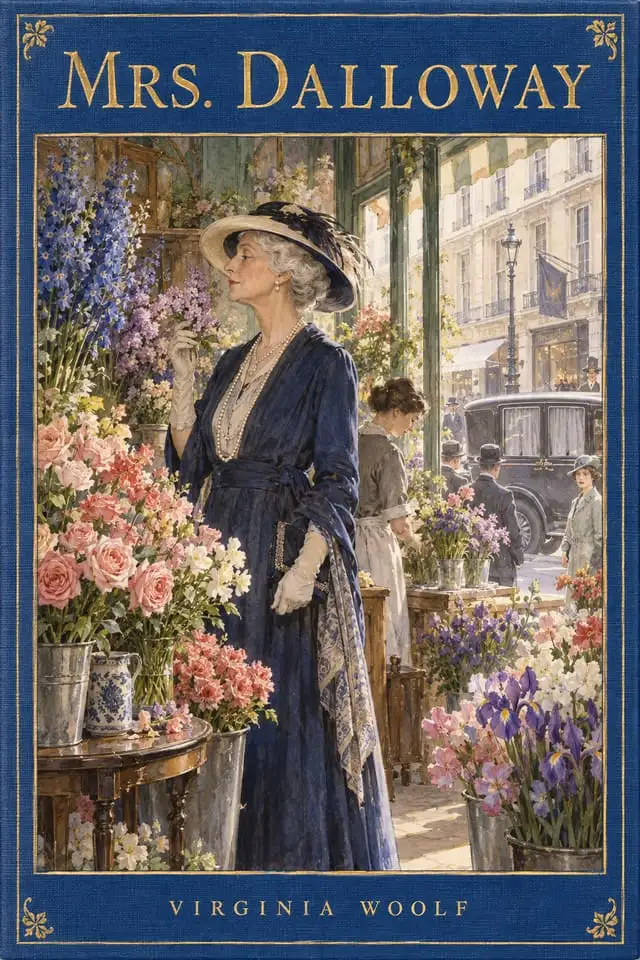
Characters
- Clarissa DallowayA woman living in Westminster who is buying flowers for her party and recalling her youth at Bourton.First appears: Mrs. Dalloway
- Peter WalshAn old friend whose arguments, habits and letters remain vivid in Clarissa's memory after his years in India.First appears: Mrs. Dalloway
- Richard DallowayClarissa's husband, whose political work gives them separate occupations during the day.First appears: Mrs. Dalloway
- Sally SetonA friend from Clarissa's youth at Bourton, remembered for her daring and disregard for convention.First appears: Mrs. Dalloway
- Hugh WhitbreadA childhood friend of Clarissa's, carefully dressed and occupied with his wife Evelyn's health and his duties at Court.First appears: Mrs. Dalloway
- Elizabeth DallowayClarissa and Richard's daughter, whose closeness to Miss Kilman troubles her mother.First appears: Mrs. Dalloway
- Miss KilmanElizabeth's history teacher, whom Clarissa resents and Richard considers able.First appears: Mrs. Dalloway
- Septimus Warren SmithA young man whose frightened perceptions make an ordinary London street feel threatening.First appears: Mrs. Dalloway
- Lucrezia Warren SmithSeptimus's Italian wife, who tries to guide him through London while worrying about his state of mind.First appears: Mrs. Dalloway
- Dr HolmesThe doctor who has told Rezia to encourage her husband to notice things outside himself.First appears: Mrs. Dalloway
- EvansA man from Septimus's wartime life whom Septimus believes he can see and hear.First appears: Mrs. Dalloway
- Sir William BradshawA respected specialist whom Rezia hopes will help her husband.First appears: Mrs. Dalloway
- Lady BrutonA well-connected woman interested in politics who has invited Richard to lunch.First appears: Mrs. Dalloway
- LucyA servant in the Dalloways' house who is helping prepare for the party.First appears: Mrs. Dalloway
- Ellie HendersonClarissa's cousin, whose wish to attend the party reaches Clarissa through a mutual acquaintance.First appears: Mrs. Dalloway
- Mrs FilmerThe landlady at Septimus and Rezia's London lodgings.First appears: Mrs. Dalloway
Themes
- Identity and social roles
- Time and memory
- Connection and solitude
- Power and conformity
- War and suffering
- Gender and choice
- Class and empire
- Life and mortality
Chapter summaries
Mrs. Dalloway
On a June day in London, Clarissa Dalloway buys flowers for her evening party and remembers her youth at Bourton, including her relationships with Peter Walsh and Sally Seton. Peter unexpectedly returns from India, and their meeting exposes affection and resentment that neither can settle. Meanwhile, the former soldier Septimus Warren Smith experiences terrifying visions and guilt, while his wife Rezia struggles to obtain help from Dr Holmes and Sir William Bradshaw. Bradshaw proposes separating the couple, and, after a brief spell of shared happiness making a hat, Septimus kills himself when Holmes forces his way towards him. Richard brings Clarissa roses but cannot voice his love, while Elizabeth briefly escapes her mother's and Miss Kilman's competing claims through a journey around London. At the party, reunited friends and political guests mingle until news of the unknown young man's death leads Clarissa to withdraw and question both coercive power and her own pursuit of social success. She returns to the gathering, and Peter's excitement at her presence closes a narrative in which shifts between minds and remembered scenes complicate any single judgement of a life.
Key quotes
this being Mrs. Dalloway; not even Clarissa any more; this being Mrs. Richard Dalloway.
Clarissa hears her married name displacing her personal name. The repetition suggests a tension between a public role and the self she experiences privately.
Identity and social rolesGender and choice
Conversion is her name and she feasts on the wills of the weakly, loving to impress, to impose, adoring her own features stamped on the face of the populace.
The narrator turns the wish to impose one's beliefs into a hungry goddess. The passage links Bradshaw's authority to wider attempts to make other people conform.
Power and conformityClass and empire
Death was an attempt to communicate; people feeling the impossibility of reaching the centre which, mystically, evaded them; closeness drew apart; rapture faded; one was alone.
These are Clarissa's thoughts about a man she has never met, rather than a settled explanation of his death. Her imagined connection must be weighed against Septimus's earlier insistence that he does not want to die.
Connection and solitudeLife and mortalityWar and suffering
Talking points
These questions discuss the whole novel, including its ending. Use the named scenes to test your reading against the text.
How does the novel make one London day contain so much of the past?
Compare Clarissa's opening walk, Peter's memories of Bourton and the reunion at the party. Examine how clock strikes, sensations and remembered words move the narrative between different times.
Look again at: Mrs. Dalloway
How far does Clarissa's party create the connections she hopes for?
Read her account of an offering alongside the work of Lucy and Mrs Walker, Ellie Henderson's isolation and the arrival of the Prime Minister. Consider whose experiences complicate the hostess's account.
Look again at: Mrs. Dalloway
What separates intimacy from the wish to possess another person?
Compare Clarissa's reasons for refusing Peter, Richard's unspoken declaration, Miss Kilman's attachment to Elizabeth and Rezia's conversations with Septimus. Attend to moments of understanding as well as failed communication.
Look again at: Mrs. Dalloway
What possibilities for women does the novel open and restrict?
Set Clarissa's thoughts about her married name beside Sally's remembered rebellion, Miss Kilman's teaching and Elizabeth's journey along the Strand. Distinguish the futures people imagine from choices the narrative actually shows.
Look again at: Mrs. Dalloway
How does the novel ask us to judge the care offered to Septimus and Rezia?
Compare Holmes's reassurance, Bradshaw's proposed separation and the couple's shared work on the hat. Examine how each scene treats speech, listening, authority and the wishes of the people seeking help.
Look again at: Mrs. Dalloway
What are the possibilities and limits of Clarissa's response to the young man's death?
Compare what the reader witnesses in Septimus's room with what the Bradshaws tell Clarissa and what she imagines alone. Consider both her sense of affinity and how little she knows of his life.
Look again at: Mrs. Dalloway
How does London connect private lives to public ideas of nation, class and empire?
Follow the unidentified motorcar, the marching boys, Lady Bruton's emigration scheme and Peter's response to the ambulance. Ask how different viewpoints support or unsettle the language of civilisation and service.
Look again at: Mrs. Dalloway
Does the ending make people more knowable, or leave their judgments uncertain?
Compare Peter's mistaken belief that Aunt Helena is dead, Sally's admission that she jumps to conclusions and Peter's final excitement when Clarissa appears. Examine how a confident statement can coexist with incomplete understanding.
Look again at: Mrs. Dalloway