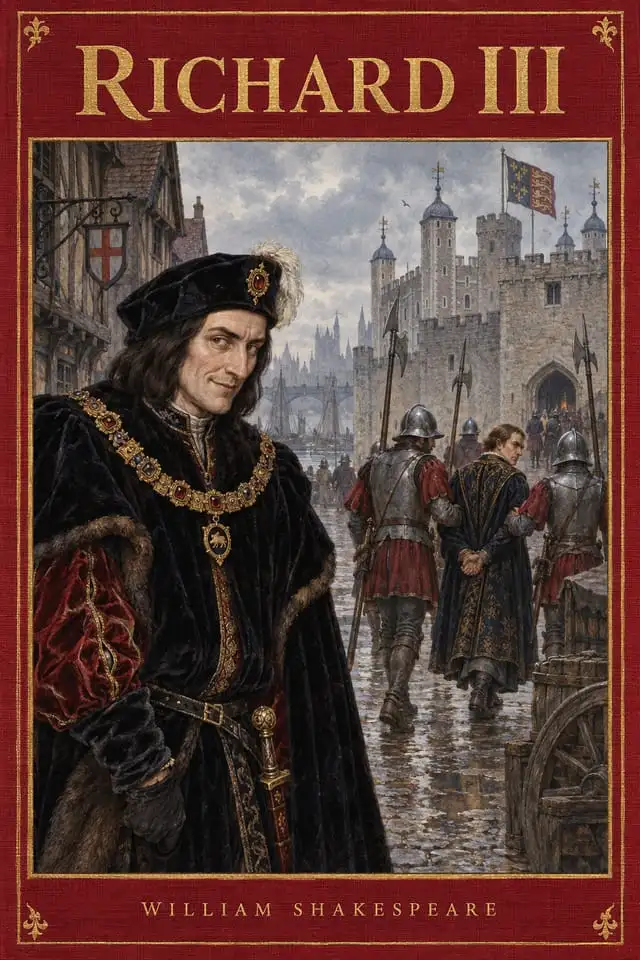
Characters
- King RichardHe is killed fighting Richmond, and his crown passes to the victor.First appears: Act 1, Scene 1
- ClarenceHaunted by a dream of drowning and of being accused in the underworld of perjury and murder, he pleads for his life and refuses to believe that Richard sent the murderers, until the First Murderer stabs him.First appears: Act 1, Scene 1
- BrakenburyAs Clarence's keeper in the Tower, he hands him over to the murderers when they show their commission, choosing not to ask what it means.First appears: Act 1, Scene 1
- Lord HastingsCondemned without a hearing, he recognises his false security and recalls Margaret's curse before being led to execution.First appears: Act 1, Scene 1
- King Henry the SixthThe dead Lancastrian king whose corpse Lady Anne accompanies in mourning.First appears: Act 1, Scene 2
- Lady AnneRichard reports that she has died, without describing the circumstances of her death.First appears: Act 1, Scene 2
- Queen ElizabethDerby reports that she has consented to her daughter's marriage to Richmond.First appears: Act 1, Scene 3
- Lord RiversLed to execution at Pomfret, he protests his loyalty, remembers Margaret's curse and prays for his sister and her sons.First appears: Act 1, Scene 3
- Lord GreyFacing execution, he interprets his fate as the fulfilment of Margaret's curse for his presence at her son's murder.First appears: Act 1, Scene 3
- BuckinghamLed to execution, he admits his wrongdoing and interprets his betrayal by Richard through his own oath and Margaret's warning.First appears: Act 1, Scene 3
- Lord Stanley (Derby)He brings Richard's crown to Richmond and confirms that his son George is alive and safe.First appears: Act 1, Scene 3
- DorsetStanley reports that he has fled to Richmond overseas.First appears: Act 1, Scene 3
- Queen MargaretShe watches her enemies' losses as revenge for her own and teaches Elizabeth to turn grief into curses before leaving for France.First appears: Act 1, Scene 3
- CatesbyHe helps present Richard as unwilling to abandon prayer for a meeting with the mayor and citizens.First appears: Act 1, Scene 3
- First MurdererHe overcomes a brief stirring of conscience, stabs Clarence and plans to hide the body until Richard orders its burial.First appears: Act 1, Scene 3
- Second MurdererTroubled by conscience before and after the killing, he leaves the stabbing to his partner, repents the murder and refuses his share of the fee.First appears: Act 1, Scene 3
- King EdwardHe has died, leaving his young son, the prince, as heir to the throne.First appears: Act 2, Scene 1
- Duchess of YorkAfter sharing the other women's grief, she curses Richard and prays for the success of his enemies.First appears: Act 2, Scene 2
- Clarence's sonClarence's young son, called Boy in the speech headings, who asks his grandmother whether his father is dead.First appears: Act 2, Scene 2
- Clarence's daughterClarence's young daughter, called Girl in the speech headings, who joins her brother in questioning their grandmother.First appears: Act 2, Scene 2
- RatcliffHe attends Richard before battle and hears his fear that his friends may betray him.First appears: Act 2, Scene 2
- First CitizenA Londoner who hopes that all will be well now that the dead king's son is to reign.First appears: Act 2, Scene 3
- Second CitizenA Londoner who fears a troublous world after the king's death and says that men everywhere are full of dread.First appears: Act 2, Scene 3
- Third CitizenA Londoner who warns of the danger of a child king and names the Duke of Gloucester and the queen's proud kinsmen as the threat.First appears: Act 2, Scene 3
- Archbishop of YorkA churchman waiting with the royal women for news of the prince on his journey to London.First appears: Act 2, Scene 4
- Duke of YorkHe jokes with Richard about his size and weapons but fears the Tower because Clarence was murdered there.First appears: Act 2, Scene 4
- MessengerHe brings news that Rivers, Grey and Vaughan have been made prisoners but cannot say why.First appears: Act 2, Scene 4
- Prince EdwardThe young heir to King Edward, arriving in London after his father's death.First appears: Act 3, Scene 1
- The Lord MayorHe accepts Richard and Buckingham's account of Hastings's supposed treason and promises to repeat it to the citizens.First appears: Act 3, Scene 1
- Cardinal BourchierThe cardinal accompanying the prince and the lords on their arrival in London.First appears: Act 3, Scene 1
- Sir Thomas VaughanCondemned with Rivers and Grey, he warns that those responsible will suffer for their deaths.First appears: Act 3, Scene 3
- The Bishop of ElyHe attends the coronation council and sends for strawberries at Richard's request.First appears: Act 3, Scene 4
- LovelOne of the men attending the council in the Tower.First appears: Act 3, Scene 4
- The scrivenerA copyist carrying the formal indictment against Hastings.First appears: Act 3, Scene 6
- James TyrrelHe reports that Dighton and Forrest smothered the princes and were afterwards overcome by remorse.First appears: Act 4, Scene 2
- RichmondAfter killing Richard, he receives the crown, pardons returning soldiers and proposes to unite the royal houses by marrying Elizabeth.First appears: Act 4, Scene 1
- Sir Christopher UrswickHe carries messages between Derby and Richmond and reports the supporters gathering around Richmond.First appears: Act 4, Scene 5
- The Duke of NorfolkA commander in Richard's army, attending him at Bosworth.First appears: Act 5, Scene 3
- OxfordA supporter of Richmond who presents conscience as a source of strength against Richard.First appears: Act 5, Scene 2
- BluntHe argues that Richard's followers serve from fear rather than friendship.First appears: Act 5, Scene 2
- HerbertHe expects Richard's supporters to desert to Richmond.First appears: Act 5, Scene 2
- The Earl of SurreyOne of Richard's commanders, he is assigned to help lead the forward force.First appears: Act 5, Scene 3
- Sir William BrandonRichmond appoints him to bear his standard in battle.First appears: Act 5, Scene 3
Themes
- Ambition and kingship
- Deception and performance
- Conscience and divine justice
- Curses, prophecies and dreams
- Women and grief
- Family, faction and civil war
- Deformity and the body
Chapter summaries
Act 1, Scene 1
Richard opens the play with a soliloquy that contrasts the celebrations after the house of York's victory with his own body, which he calls deformed and unfinished. Claiming he cannot play the lover in this time of peace, he declares himself determined to prove a villain and reveals that he has used a prophecy about the letter G to set King Edward against their brother George, Duke of Clarence. When Clarence is led to the Tower under Brakenbury's guard, Richard blames the queen, says that she and her brother also had Hastings imprisoned, jokes about Mistress Shore and swears to free him. As soon as Clarence has gone, Richard says he loves him so much that he will shortly send his soul to heaven. Hastings, freed from the Tower that day, reports that the king is ill, and Richard hopes Edward will live just long enough for Clarence to die. He then plans to marry Warwick's youngest daughter, although he admits killing her husband and her father. Because Richard shares his plans with the audience, everyone watching knows his concern for Clarence is an act, which gives the scene its dramatic irony.
Act 1, Scene 2
Anne leads King Henry's corpse towards Chertsey, calling on his ghost to hear her grief and cursing the man who killed both him and her husband, Henry's son Edward. Richard halts the bearers with threats, and when the corpse's wounds bleed afresh, Anne takes it as a sign of his guilt. In a quick exchange of matching lines he answers her insults with flattery, first denying the murders and then admitting them while blaming her beauty. He kneels, bares his breast and offers her his sword, but she cannot strike, and she ends by taking his ring and agreeing to go to Crosby Place. Once she has gone, he redirects the corpse to White-Friars instead of Chertsey. In soliloquy he gloats at winning a widow whose husband he stabbed at Tewksbury some three months earlier, and mockingly plans to buy a looking-glass, turning his complaint about his body in the first scene into a joke at Anne's expense.
Act 1, Scene 3
Queen Elizabeth worries that if the king dies, her young son will be in the care of Richard as protector, a man she says loves none of her family. Buckingham, who has visited the king with Derby, reports his wish to reconcile Richard with the queen's brothers, and them with Hastings. Richard enters playing the plain, honest man wronged by flatterers, accuses the queen of causing the imprisonment of Clarence and Hastings, and mocks her marriage and the new honours given to her family. Queen Margaret, King Henry's widow, comments unseen before stepping forward to claim the queen's place as hers and to curse the king, the queen, her son, Rivers, Dorset, Hastings and, at greatest length, Richard. Richard turns her final curse back on her by speaking her name at its end, the quarrelling lords unite against her, and Buckingham shrugs off her warning. Left alone, Richard explains how he blames others for his own secret mischief and quotes scripture to seem a saint, then gives the waiting murderers the warrant and tells them not to listen to Clarence.
Act 1, Scene 4
Clarence describes a dream in which Richard stumbled on a ship's deck and knocked him into the sea, where he saw jewels lying in dead men's skulls before his soul was ferried to the kingdom of perpetual night. There Warwick, his father-in-law, accused him of perjury, and a shadow like an angel, with blood in its bright hair, called him the man who stabbed him at Tewksbury. Clarence admits that he did these things for Edward's sake and prays that his wife and children be spared. Brakenbury reads the murderers' commission and hands over the keys, choosing not to ask what it means. In prose that turns the killing into dark comedy, the Second Murderer's conscience is stirred by the word 'judgment' and then forgotten at the thought of the reward. When Clarence wakes, he argues that murder breaks God's law, and the murderers answer that he broke his own oath to the house of Lancaster and killed his sovereign's son. Clarence's faith that Richard loves him, set against what the audience knows, creates sharp dramatic irony before the First Murderer stabs him and the Second Murderer refuses his fee.
Act 2, Scene 1
King Edward, sick and expecting to die soon, makes Rivers and Hastings, the queen, Dorset and Buckingham swear to end their quarrels, and Buckingham asks God to punish him through false friends if he ever turns against the queen's family. Richard enters and makes a show of humility, offering to make peace with anyone he may have offended and claiming to be no more at odds with anyone than a newborn baby. When the queen asks the king to take Clarence back into favour, Richard announces Clarence's death as if everyone knew of it, and the whole court turns pale. He claims the king's first order travelled swiftly while the countermand came too late, and hints that others with bloodier thoughts go unsuspected. Derby's plea for his servant's life provokes the king into a speech of remorse, recalling how Clarence saved his life and asking why no one spoke for him, and he fears God's justice on them all. The audience, who saw Richard send murderers to Clarence, watches him blame the queen's kindred for a death he arranged, so the scene is full of dramatic irony.
Act 2, Scene 2
The Duchess of York tries to hide Clarence's death from his son and daughter, but the boy repeats what Richard told him: that the king, provoked by the queen, imprisoned Clarence, and that Richard wept and promised to love him like a father. The Duchess calls this kindness a mask over foul guile and says Richard is her shame. Queen Elizabeth enters with her hair loose to announce King Edward's death, and she, the children and the Duchess mourn in a formal, patterned lament, answering one another line for line as each claims the greatest loss. Dorset and Rivers urge the queen to think of her son, the prince, and have him crowned. Richard kneels for his mother's blessing and mocks it in an aside. Buckingham persuades the lords that the prince should be fetched from Ludlow with a small escort so that old quarrels do not break out again, then privately offers Richard the chance to cut the prince off from the queen's kindred, as part of a plan the two have already discussed. Richard calls him 'my other self' and promises to follow his lead, showing that he now has a partner in his schemes.
Act 2, Scene 3
Three ordinary Londoners meet and share the news of King Edward's death. The Second and Third Citizens expect a 'troublous world', while the First Citizen trusts that the king's son will reign and that all will be well. The Third Citizen warns of the danger of rule by a child, and when the First Citizen recalls Henry the Sixth, crowned at nine months old, he replies that Henry had wise counsel and virtuous uncles. He names the Duke of Gloucester as full of danger and the queen's sons and brothers as proud, and fears their rivalry over who will be nearest the young king. His images from nature, of clouds before rain, falling leaves before winter and waters swelling before a storm, express a common feeling that trouble is coming. The scene shows how the quarrels of the great look to the ordinary people who must live under them.
Act 2, Scene 4
The Archbishop reports that the prince's party is on its way to London, and the Duchess longs to see how the prince has grown. Young York repeats Richard's saying that 'great weeds do grow apace' and wishes he had answered with the story that Richard could gnaw a crust at two hours old; the Duchess says Richard was slow to grow, and the queen calls her son a 'parlous boy'. The mood changes when a messenger reports that Rivers, Grey and Sir Thomas Vaughan have been sent to Pomfret as prisoners by Richard and Buckingham, for reasons he does not know. Queen Elizabeth sees the ruin of her house in this news, picturing tyranny as a tiger that has seized a gentle deer, and the Duchess laments a lifetime of civil war in which the conquerors now make war on themselves. The queen takes York to sanctuary, and the Archbishop offers to hand her the seal he keeps. The audience can connect the arrests with the plan Buckingham shared with Richard at the end of the previous scene, while the women can only grieve and seek safety.
Act 3, Scene 1
The prince challenges Richard's account of his missing uncles and reluctantly accepts the Tower as his lodging. Buckingham argues that a child cannot claim sanctuary, overriding the Cardinal's scruples in order to bring York to his brother. The boys' wit tests Richard's ability to control the conversation, while his asides expose the hostility concealed by his courtesy. Once they have gone, Buckingham sends Catesby to discover whether Hastings will support Richard's claim to the crown. Richard's answer to possible resistance is beheading, and his promise of property to Buckingham shows the rewards attached to their alliance.
Act 3, Scene 2
Stanley sends a warning about a dream of the boar and the danger of two separate councils. Hastings trusts Catesby as his source of information, although the audience has seen Catesby receive his orders from Richard and Buckingham. He firmly refuses to displace Edward's heirs, yet celebrates the planned execution of his own enemies. Catesby's and Buckingham's asides give a second, threatening meaning to their apparently friendly words. Hastings's confidence thus reveals both his loyalty to the princes and the factional hatred that prevents him recognising his own danger.
Act 3, Scene 3
The condemned men present themselves as loyal subjects rather than traitors. Rivers connects the prison with an earlier royal killing, making the setting part of a longer account of violence. Grey reads their deaths through Margaret's curse for their presence at her son's murder. Rivers asks God to hear her prayers against their enemies but spare his sister and her sons. Their final embrace gives family and fellowship a dignity absent from the political orders that bring them to death.
Act 3, Scene 4
The council begins with plans for the prince's coronation and Richard's courteous request for strawberries. Richard privately tells Buckingham that Catesby has found Hastings unwilling to support his accession, after which the two men leave and return with accusations of witchcraft. Richard displays his withered arm as evidence, although he described his bodily difference at the play's opening. Hastings's conditional answer becomes the pretext for an immediate death sentence. Left with his executioners, he remembers Stanley's dream, his horse's behaviour and his own pleasure at his enemies' deaths. His final speech contrasts the unstable favour of powerful men with the grace of God.
Act 3, Scene 5
The scene begins by showing Richard and Buckingham rehearse the appearance of terror. Hastings's severed head then becomes a prop in their false account of an emergency that supposedly required his execution. The mayor accepts their words as sufficient evidence and promises to repeat them to the citizens. Richard next instructs Buckingham to spread allegations about Edward's children and Edward himself. His concern about mentioning his living mother exposes the personal cost of the story he wants told. The closing orders isolate Clarence's children and the princes, extending the control of speech into control of access to people.
Act 3, Scene 6
The scrivener brings a written indictment intended for public reading. Its preparation took longer than the interval since Hastings was alive and free, exposing a prosecution arranged in advance. This practical account of copying documents supplies evidence against the public version of his death. The speaker distinguishes recognising the fraud from daring to say so. His brief appearance broadens the play's account of tyranny beyond the court to those who must circulate its claims.
Act 3, Scene 7
Buckingham admits that his account of Richard's fitness to rule produced silence rather than public enthusiasm. He turns a few followers' shouts into an announcement of general applause. The two men then arrange another performance, with Richard presented as absorbed in religious devotion. Buckingham attacks the legitimacy of Edward's heirs and claims the throne for Richard, who repeatedly refuses it. The mayor treats the prayer-book and bishops as signs of virtue, although the audience has heard the plan. Richard's final acceptance also shifts responsibility to those supposedly forcing him to rule.
Act 4, Scene 1
The women's different family claims cannot overcome the order barring them from the princes. Brakenbury's accidental use of 'king' for Richard makes the transfer of authority audible before Stanley announces the coronation. Anne receives her elevation with horror, describing a crown she wishes were deadly rather than glorious. She recalls her curse against Richard's future wife and interprets her own marriage as its fulfilment. Her account of his fearful dreams places private suffering beside the public ceremonies of power. Elizabeth's farewell to the Tower gives its stones the care she is prevented from offering her sons.
Act 4, Scene 2
Richard's first scene as crowned king presents possession of the throne as a source of further insecurity. He presses Buckingham to consent to the princes' deaths, treating hesitation as disloyalty. A page recommends Tyrrel as a man whose ambition and poverty make him susceptible to money. Richard orders rumours of Anne's illness and announces privately his intention to marry his brother's daughter. Buckingham's claim to the promised earldom meets evasions, as Richard dwells on prophecies involving Richmond. Their partnership ends with Buckingham remembering Hastings and seeking safety before he suffers the same fate.
Act 4, Scene 3
The princes' deaths reach the audience through Tyrrel's account of Dighton and Forrest's words. Their description of the sleeping children and the prayer-book emphasises innocence, while their remorse recalls the earlier murderers' troubled conscience. Richard asks for confirmation of death and burial, then offers Tyrrel advancement. His own brief account of Anne and Clarence's children places several obstacles to his rule among matters already disposed of. He plans to marry Elizabeth in order to obstruct Richmond's claim through her. News of revolt interrupts this calculation and turns his attention to urgent military action.
Act 4, Scene 4
The three women measure their losses against one another, joining shared grief to an unresolved history of revenge. Margaret teaches Elizabeth to turn memory into curses, while the Duchess directs her own curse against her son. Richard tries to drown the women out with military noise, but then seeks Elizabeth's assistance with his proposed marriage. She repeatedly exposes the killings and broken oaths beneath his promises of future benefit. She leaves promising to discover her daughter's mind, which Richard interprets as weakness rather than supplying proof of agreement. The influx of military reports unsettles his command: he gives incomplete or contradictory orders and strikes a messenger before hearing good news. Holding Stanley's son as a pledge turns Richard's suspicion into a threat against another family.
Act 4, Scene 5
The short exchange reveals a political purpose hidden from Richard's knowledge. Derby's account of his imprisoned son explains why his actions cannot openly match his allegiance. Urswick supplies the names of men gathering around Richmond and their movement towards London. The report of Elizabeth's consent to Richmond's marriage challenges Richard's confident judgement of her in the preceding scene. Letters and messengers thus provide a means of resistance alongside the preparations for battle.
Act 5, Scene 1
Buckingham addresses the dead whose suffering helped secure Richard's power. His account acknowledges injustice rather than claiming that his own service was innocent. The day reminds him of the punishment he invoked when promising loyalty to Edward's family. He now interprets that prayer as a false performance turned into a real sentence. Margaret's warning supplies a further pattern through which he understands his betrayal and impending death.
Act 5, Scene 2
Richmond speaks as a commander sustained by Stanley's encouraging letters. His description of Richard as a destructive boar turns the ruler into an animal feeding on the country. He promises peace through a final bloody encounter, joining the hope of restoration to the necessity of violence. Oxford presents conscience as a military force, while Blunt argues that fear cannot create lasting friendship. The scene introduces Richmond's public account of his cause before the armies meet.
Act 5, Scene 3
The alternating camps set Richard's larger force against Richmond's claims of moral support. Stanley promises what aid he can while fearing for his hostage son. The ghosts address both leaders, making their contrasting judgements visible to the audience. Richard's waking soliloquy breaks his confident self-command into questions, accusations and denials, as conscience takes the form of an internal trial. Richmond interprets his dream as reassurance and urges his soldiers to fight for God, country and their families. Richard dismisses conscience and appeals to fear of dispossession and foreign enemies, although his earlier terror complicates the dismissal. Stanley's refusal to bring his forces leads Richard to order George's death, which Norfolk postpones until after the battle.
Act 5, Scene 4
The scene gives Richard physical courage even as his position deteriorates. Catesby's account presents him fighting beyond ordinary expectation rather than simply fleeing defeat. Richard treats his life as a stake already cast on a die. His repeated offer of the kingdom for a horse measures royal possession against an immediate practical need. The battle thus reduces the power sought throughout the play to the means of continuing a personal fight.
Act 5, Scene 5
Richard's death takes place in combat rather than in a final explanatory speech. Derby transfers the crown to Richmond, who immediately asks after the hostage George. The list of casualties acknowledges losses among named men before the victor orders suitable burial. Richmond's pardon invites former opponents back into the political community. His proposed marriage presents the two royal houses as joined after the repeated violence between parents, children and brothers. The closing prayer offers peace as the purpose of victory, while its attack on future traitors shows that the new settlement still defines enemies.
Key quotes
Now is the winter of our discontent Made glorious summer by this sun of York;
The opening lines celebrate the end of war with a pun on 'sun' and 'son' that points to King Edward, a son of the house of York. The rest of the speech shows that Richard himself takes no pleasure in this peace.
Ambition and kingshipFamily, faction and civil war
And therefore, since I cannot prove a lover, To entertain these fair well-spoken days, I am determined to prove a villain
Richard presents his villainy as a choice that follows from his sense of being shut out of love by his body. 'Determined' can mean both resolved and fated, so the line leaves open how far he is responsible.
Deformity and the bodyAmbition and kingshipDeception and performance
Simple, plain Clarence! I do love thee so, That I will shortly send thy soul to heaven,
Spoken as soon as Clarence leaves, these lines turn Richard's promise of help into a death threat. The audience now shares a secret that Clarence does not know.
Deception and performanceFamily, faction and civil war
O, gentlemen, see, see! dead Henry's wounds Open their congeal'd mouths and bleed afresh!
Anne reads the bleeding corpse as a sign of Richard's guilt and calls on God and earth to revenge the king. The image of the wounds as mouths makes the dead king seem to speak against his killer.
Conscience and divine justiceWomen and grief
Arise, dissembler: though I wish thy death, I will not be the executioner.
Anne still sees Richard as a liar, yet she cannot kill him. Her refusal is the turning point of the wooing, after which he presses her for more.
Deception and performanceWomen and grief
Was ever woman in this humour woo'd? Was ever woman in this humour won? I'll have her; but I will not keep her long.
Richard gloats to the audience about his own performance. The repeated question shows his delight in the challenge, and the last line reveals that the courtship was a means to an end.
Deception and performanceAmbition and kingshipWomen and grief
Cannot a plain man live and think no harm, But thus his simple truth must be abused By silken, sly, insinuating Jacks?
Richard casts himself as a blunt, honest man and his enemies as smooth courtiers. The audience, who have heard his soliloquies, know that this plainness is itself a performance.
Deception and performanceFamily, faction and civil war
The worm of conscience still begnaw thy soul! Thy friends suspect for traitors while thou livest, And take deep traitors for thy dearest friends!
Margaret curses Richard with guilt and with mistrust of the wrong people. Her curse attacks his mind as well as his fortunes, wishing on him the inner torment he shows no sign of feeling.
Curses, prophecies and dreamsConscience and divine justiceWomen and grief
And thus I clothe my naked villany With old odd ends stolen out of holy writ; And seem a saint, when most I play the devil.
Richard openly describes religion as a costume he wears to hide his villainy. The contrast between saint and devil sums up the gap between his public face and his private aims.
Deception and performanceConscience and divine justice
Clarence is come; false, fleeting, perjured Clarence, That stabb'd me in the field by Tewksbury;
In Clarence's dream, one of his victims accuses him in the underworld. The scene shows that Richard is not the only member of the house of York with blood on his hands.
Conscience and divine justiceCurses, prophecies and dreamsFamily, faction and civil war
I'll not meddle with it: it is a dangerous thing: it makes a man a coward:
The Second Murderer talks about conscience as if it were a troublesome neighbour. His comic prose makes a serious point about how easily reward silences moral feeling.
Conscience and divine justice
How fain, like Pilate, would I wash my hands Of this most grievous guilty murder done!
The Second Murderer wishes he could disown the killing as Pilate tried to disown Christ's death. Calling it a 'grievous guilty murder' shows that he cannot escape his share of the guilt.
Conscience and divine justice
I do not know that Englishman alive With whom my soul is any jot at odds More than the infant that is born to-night: I thank my God for my humility.
Richard plays the innocent peacemaker in front of the whole court. Thanking God for his own humility is a boast dressed as modesty, and the audience knows his plots.
Deception and performanceFamily, faction and civil war
But he, poor soul, by your first order died, And that a winged Mercury did bear; Some tardy cripple bore the countermand, That came too lag to see him buried.
Richard explains Clarence's death as an accident of timing, sounding sorry while making sure the king feels the blame. His image of a 'tardy cripple' is striking from a man who has called his own body deformed.
Deception and performanceDeformity and the bodyAmbition and kingship
O God, I fear thy justice will take hold On me, and you, and mine, and yours for this!
The king accepts guilt for his brother's death and fears that God will punish his whole family and court. His remorse contrasts with Richard, who shows none.
Conscience and divine justiceFamily, faction and civil war
Oh, that deceit should steal such gentle shapes, And with a virtuous vizard hide foul guile! He is my son; yea, and therein my shame;
Richard's own mother sees through his kindness to the children. Her words show that his deceit is now suspected inside his family, and her shame adds a mother's grief to the play's picture of him.
Deception and performanceWomen and griefFamily, faction and civil war
Amen; and make me die a good old man! That is the butt-end of a mother's blessing:
In an aside, Richard turns a sacred moment into a joke for the audience. He kneels in public but shares his contempt with us in private.
Deception and performance
My other self, my counsel's consistory, My oracle, my prophet! My dear cousin, I, like a child, will go by thy direction.
Richard flatters Buckingham as his second self and his guide. Calling himself 'like a child' is part of the flattery, since the audience has seen him lead every plot so far.
Ambition and kingshipDeception and performanceFamily, faction and civil war
Woe to the land that's govern'd by a child!
The Third Citizen sums up the danger facing the kingdom in one line. A child king cannot rule himself, so power will lie with whoever controls him.
Ambition and kingshipFamily, faction and civil war
O, full of danger is the Duke of Gloucester! And the queen's sons and brothers haught and proud:
The Third Citizen offers a view of the court's rivalry from outside it. His warning shows that Richard's public reputation is contested, despite his performance of plain honesty.
Family, faction and civil warAmbition and kingshipDeception and performance
By a divine instinct men's minds mistrust Ensuing dangers; as, by proof, we see The waters swell before a boisterous storm.
The citizen suggests that God gives people a sense of coming trouble. The idea links the fears of ordinary people to the play's interest in warnings and divine justice.
Curses, prophecies and dreamsConscience and divine justice
Small herbs have grace, great weeds do grow apace:
Richard's saying, repeated by the boy, compares his nephew's quick growth to a weed's. The Duchess turns it against Richard, who was slow to grow, so the scene keeps returning to his body.
Deformity and the bodyFamily, faction and civil war
Ay me, I see the downfall of our house! The tiger now hath seized the gentle hind;
The queen understands at once what the arrests mean for her family. The image of a tiger and a deer presents the struggle for power as predator against helpless prey.
Ambition and kingshipWomen and griefFamily, faction and civil war
Make war upon themselves; blood against blood, Self against self:
The Duchess sees the house of York, having won the crown, turning on itself. The repeated words show civil war as a family destroying its own members.
Family, faction and civil warWomen and grief
Chop off his head, man; somewhat we will do:
Richard's blunt answer strips away the politeness of his public dealings and exposes violence as the means of securing consent.
Ambition and kingshipDeception and performanceFamily, faction and civil war
I’ll have this crown of mine cut from my shoulders Ere I will see the crown so foul misplaced.
The pun joins Hastings's head to the royal crown, making his refusal emphatic while the audience already knows Richard's proposed response.
Family, faction and civil warDeception and performanceCurses, prophecies and dreams
Now Margaret’s curse is fall’n upon our heads,
Grey supplies an explicit interpretation of the executions as the fulfilment of Margaret's words; the claim belongs to a participant facing death.
Curses, prophecies and dreamsFamily, faction and civil warConscience and divine justice
If! thou protector of this damned strumpet, Tellest thou me of “ifs”? Thou art a traitor:
Richard converts a qualification into proof of guilt. The interruption lets the audience hear how an accusation replaces any inquiry into evidence.
Ambition and kingshipDeception and performanceCurses, prophecies and dreamsConscience and divine justice
Tut, I can counterfeit the deep tragedian;
Buckingham describes political deception through acting, and the audience sees the rehearsal before the mayor sees the performance.
Deception and performanceAmbition and kingshipFamily, faction and civil war
Yet who’s so blind, but says he sees it not?
The paradox suggests that silence can be imposed even when the deception is obvious, complicating any assumption that public acceptance means belief.
Deception and performanceAmbition and kingshipConscience and divine justice
Play the maid’s part, still answer nay, and take it.
Buckingham reduces Richard's apparent refusal to an agreed role, allowing the audience to measure every later expression of humility against their rehearsal.
Deception and performanceAmbition and kingshipConscience and divine justice
Rough cradle for such little pretty ones!
Elizabeth imagines the prison as a nursery, making the distance between royal power and vulnerable childhood painfully clear.
Women and griefAmbition and kingshipCurses, prophecies and dreams
But I am in So far in blood that sin will pluck on sin:
Richard recognises that protecting power gained by violence requires further violence; the image presents his security as an expanding obligation to kill.
Ambition and kingshipFamily, faction and civil warCurses, prophecies and dreamsConscience and divine justice
Thus both are gone with conscience and remorse;
Tyrrel's report attributes moral distress to the killers, contrasting their reaction with Richard's concern to confirm the result and reward it.
Conscience and divine justiceWomen and griefAmbition and kingshipFamily, faction and civil war
Plead what I will be, not what I have been;
Richard asks Elizabeth to replace the evidence of his actions with a promise about his future, while her replies insist on the dead who cannot be restored.
Women and griefCurses, prophecies and dreamsDeception and performanceAmbition and kingshipFamily, faction and civil war
Tell him the queen hath heartily consented He shall espouse Elizabeth her daughter.
The message gives a different outcome to Elizabeth's negotiations from the one Richard assumed, showing how limited his understanding of her intentions is.
Deception and performanceWomen and griefFamily, faction and civil war
And given in earnest what I begg’d in jest.
Buckingham contrasts a performed oath with its felt consequences, giving a moral weight to words he once used for political advantage.
Conscience and divine justiceCurses, prophecies and dreamsFamily, faction and civil war
Every man’s conscience is a thousand swords,
Oxford makes moral conviction a source of strength in battle, contrasting with Richard's use of fear to secure obedience.
Ambition and kingshipConscience and divine justiceFamily, faction and civil war
My conscience hath a thousand several tongues, And every tongue brings in a several tale, And every tale condemns me for a villain.
The multiplying voices turn Richard's earlier command of language into an inward prosecution; the confident speaker can no longer make himself a single agreed story.
Conscience and divine justiceCurses, prophecies and dreamsDeception and performanceAmbition and kingship
A horse! a horse! my kingdom for a horse!
The exchange reduces the crown's value to a battlefield necessity, while the repetition keeps Richard's urgency and fighting will before the audience.
Ambition and kingshipDeformity and the body
We will unite the white rose and the red:
Richmond translates rival dynastic identities into an image of union, offering a formal answer to the divided families and country described across the play.
Family, faction and civil warAmbition and kingshipConscience and divine justice
Talking points
These questions consider the whole play, including the princes' deaths and Richmond's victory. Distinguish what the audience sees from what characters report, believe or perform.
How does Richard make the audience part of his plans?
Compare his opening soliloquy, his comments after wooing Anne and his divided speech after the ghosts.
Look again at: Act 1, Scene 1, Act 1, Scene 2, Act 5, Scene 3
What makes a performance of virtue persuasive in the play?
Examine Richard's use of scripture and the rehearsal with Buckingham before the prayer-book scene.
Look again at: Act 1, Scene 3, Act 3, Scene 5, Act 3, Scene 7
How do curses and dreams relate to human choices?
Follow the speakers who remember Margaret's words, alongside the actions and decisions that bring them into danger.
Look again at: Act 1, Scene 3, Act 3, Scene 4, Act 5, Scene 1, Act 5, Scene 3
What authority do grieving women gain through speech?
Compare Anne's funeral lament, the women outside the Tower and the shared scene of curses before Richard's campaign.
Look again at: Act 1, Scene 2, Act 4, Scene 1, Act 4, Scene 4
How does the play distinguish conscience from fear?
Set the murderers' arguments beside Hastings's final recognition, Richard's waking soliloquy and the commanders' battle speeches.
Look again at: Act 1, Scene 4, Act 3, Scene 4, Act 5, Scene 3
What roles do silence and public opinion play in Richard's accession?
Look at the mayor's acceptance of the account of Hastings's death, the scrivener's observation and the citizens' response reported by Buckingham.
Look again at: Act 3, Scene 5, Act 3, Scene 6, Act 3, Scene 7
How are family relationships used to support and resist political power?
Follow the princes' removal from their mother, Stanley's hostage son and the negotiations over Elizabeth's marriage.
Look again at: Act 3, Scene 1, Act 4, Scene 4, Act 4, Scene 5, Act 5, Scene 5
How convincing is the ending's promise of peace?
Compare Richmond's final marriage plan and pardon with the play's earlier oaths of reconciliation and his words about future traitors.
Look again at: Act 2, Scene 1, Act 5, Scene 5